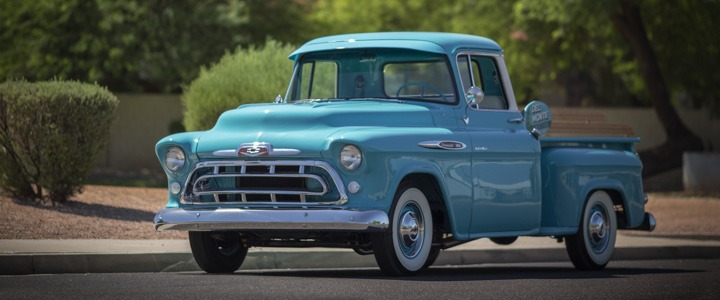
The Task Force/Blue Chip era (1955-1959) brought modern styling, introduced as a new design as the 1055 2nd Series. As Chevrolet tooled up for the “Task Force” platform, some factories continued to produce the earlier design as the 1955 1st Series, The Task Force era included the first wrap-around windshield, the fiberglass-bed Cameo, fleetside beds, and introduced V8 engine options.
• Mid-1955: With the introduction of the redesigned “Second Series” trucks, Chevrolet transitioned to a 12-volt electrical system. GMC continued to use a 6-volt system for one more year on their inline six-cylinder engines.
• Mid-1955: Chevrolet introduced a significant new engine option: a lightweight, overhead valve 265 cubic inch V-8. This modern engine offered considerably more power than the existing 235 six-cylinder with similar weight and proved to be a highly influential design for GM for many years. To compete, GMC also introduced a V-8 in 1955, a distinct engine derived from Pontiac’s V-8 and featuring a GMC logo. GMC’s V-8 would evolve in parallel with changes made to the Pontiac engine.
• 1955-1958: The Chevrolet Cameo and GMC Suburban Carrier were marketed as upscale ½-ton pickups targeting a more affluent demographic. Priced nearly 30% higher than standard models, these well-appointed trucks featured most available options but retained standard ½-ton suspension. Their most distinctive feature was the smooth-sided fiberglass bed (fleetside), a radical departure from the predominantly stepside design of the era. The Chevrolet Cameo, with its unique fiberglass bed, is now considered a rare and desirable classic.
• 1955-1959: The cab design of this period lacked a dedicated space for an optional radio speaker, which was therefore mounted overhead between the sun visors and protected by a special metal cover.
• 1955-1959: Chevrolet marketed the 3200, a long-bed ½-ton pickup with a 123-inch wheelbase that retained the standard ½-ton suspension and 6-bolt wheels. The 3600 was a ¾-ton model with the same 123-inch wheelbase but continued to use 8-bolt split-rim wheels.
• 1957-1959: Recognizing the growing popularity of four-wheel drive, General Motors offered a factory-installed system. They partnered exclusively with NAPCO (Northwestern Auto Parts Company) of Minneapolis, MN, for this system. Despite its importance, NAPCO is not mentioned in official GM documentation, though their name is visible on the front axle housing.
• 1958: General Motors followed the industry trend by introducing dual headlights. This feature was used on Chevrolet trucks through 1961 and on GMC trucks through 1972.
• Late 1958: The conventional all-steel Fleetside pickup was introduced, effectively replacing the fiberglass-bed Cameo. It was available in 6-foot and 8-foot bed lengths. The 1958-59 Fleetside bedsides had a unique horizontal “spear” protrusion for added strength, along with chrome “Fleetside” lettering on the upper rear corners. This design differed from the Fleetside bedsides used from 1960 to 1966.
I am restoring a 1957 Cameo with 43668 actual milage since the truck was idle since 1988. Actually the engine runs and I rebuilt the carburator. I do not want to use the oil bath air filter with oil so I’m looking for an element for the 2bbl carb. The elememnt for the 4bbl will not fit in the 2bbl air cleaner. Can you help me?